

Vlad Doronin’s $500 Million Deal To Scale The Aman Brand
Vladislav Doronin first encountered Aman decades ago, when he took a break from commodities trading in Hong Kong to stay at Amanpuri in Phuket, the resort that launched the brand in 1988. One holiday became a lifelong relationship.
"I started planning my travel to other Aman resorts, just like our loyal Amanjunkies do," he told me in an interview earlier this year. Amanjunkies is what the brand calls its repeat guests.
In 2014 the billionaire purchased Aman and expanded the brand's footprint from remote destinations into urban spaces. The first city property opened in Tokyo, followed by Aman New York in 2022 and Aman Nai Lert Bangkok in April 2025.
He also launched Janu, Aman’s sibling brand aimed at a more social traveler, with the first property opening in Tokyo in 2024. The Aman Club, an invitation-only membership, followed, then Aman Interiors, a design division that debuted in 2023 with a collection by Kengo Kuma. Next year, Aman at Sea takes the brand onto the water: the 180-meter Amangati will carry 47 suites with private balconies and a 2:1 staff-to-guest ratio.

Now Doronin’s OKO Group, the real estate development company he owns, has announced a joint venture with Shinsegae Property, the development arm of South Korean retail conglomerate Shinsegae Group.
The two companies describe the joint venture as a fund with an initial shared investment of $500 million to build further Aman and Janu hotels, branded residences and mixed-use commercial properties.
“We have also agreed to collaborate on mixed-use real estate developments.”
Doronin
When asked why he structured this as a joint venture this time, rather than a direct investment, Doronin tells me via email he specifically wanted to tap into Shinsegae’s "expertise in real estate development and placemaking" for future mixed-use projects.
“While the joint venture will initially focus on hotels and residences under Aman Group’s brands, Aman and Janu, we have also agreed to collaborate on mixed-use real estate developments led by OKO Group,” Doronin writes.
Details Of The $500 Million Shinsegae-OKO Deal
Historically, Doronin has functioned as both the owner/developer and the brand operator. Previous funding rounds injected capital directly into Aman Group to fund growth.
In 2022, Aman raised $900 million in a round led by Saudi Arabia’s Public Investment Fund and Cain International, then another $360 million in 2023 from investors including Mubadala Capital and Alpha Wave Ventures. Both rounds had put outside money into the Aman Group itself.
The new joint venture draws a line between his two companies and moves the heavy, risky capital requirements of real estate development into a separate vehicle.
OKO Group and Shinsegae Property carry the capital and the development risk as partners, while Aman arrives as brand and operator to earn management and licensing fees. Doronin told Bloomberg he expects the fund to keep raising for projects in the US, Asia and the Middle East.
Other conglomerates have entered the ultra-luxury hotel business through different structures. Chow Tai Fook Enterprises, the Hong Kong vehicle behind the Cheng family fortune, for example, acquired Rosewood outright in 2011 for roughly $230 million and has had Sonia Cheng run it since.
French luxury group LVMH paid $3.2 billion for Belmond and added it to its hospitality portfolio of Cheval Blanc and Bulgari Hotels, two brands it already owned and operated.
Hong Kong-based Swire Properties built its own hotel brands, the House Collective, to anchor its retail developments in Hong Kong and mainland China.
The Rising Role Of Branded Residences
Aman has sold close to $9 billion in branded residences over the past four years, Doronin told Bloomberg. Hotel-affiliated homes are now common across the hospitality industry, half of Marriott International’s new luxury hotel signings already include a residential component.
They allow for higher returns, since luxury hotels are expensive to build, capital costs are high and labor and insurance weigh on the operating statement. Branded residences sell at a premium over comparable unbranded apartments because buyers pay for the expected quality, service and professional management they associate with a luxury hotel brand.
The current global average premium buyers are willing to pay is 33 percent, 39 percent in resort markets and 30 percent in cities, according to Savills.
Branded residences also pre-sell, which means developers collect revenue before a hotel opens and can put it toward the rest of the site. Hotel companies earn revenue from branding and service fees on buildings they do not have to own.
Doronin has recently focused on more projects with branded residences and mixed-use developments. One Beverly Hills, a 17.5-acre property currently under construction with Cain International, places an Aman hotel, Aman branded residences and an Aman Club all onto a single site.
One of the penthouses there is expected to sell for $200 million. If the deal closes, it will be the most expensive condo sold in the Los Angeles area.
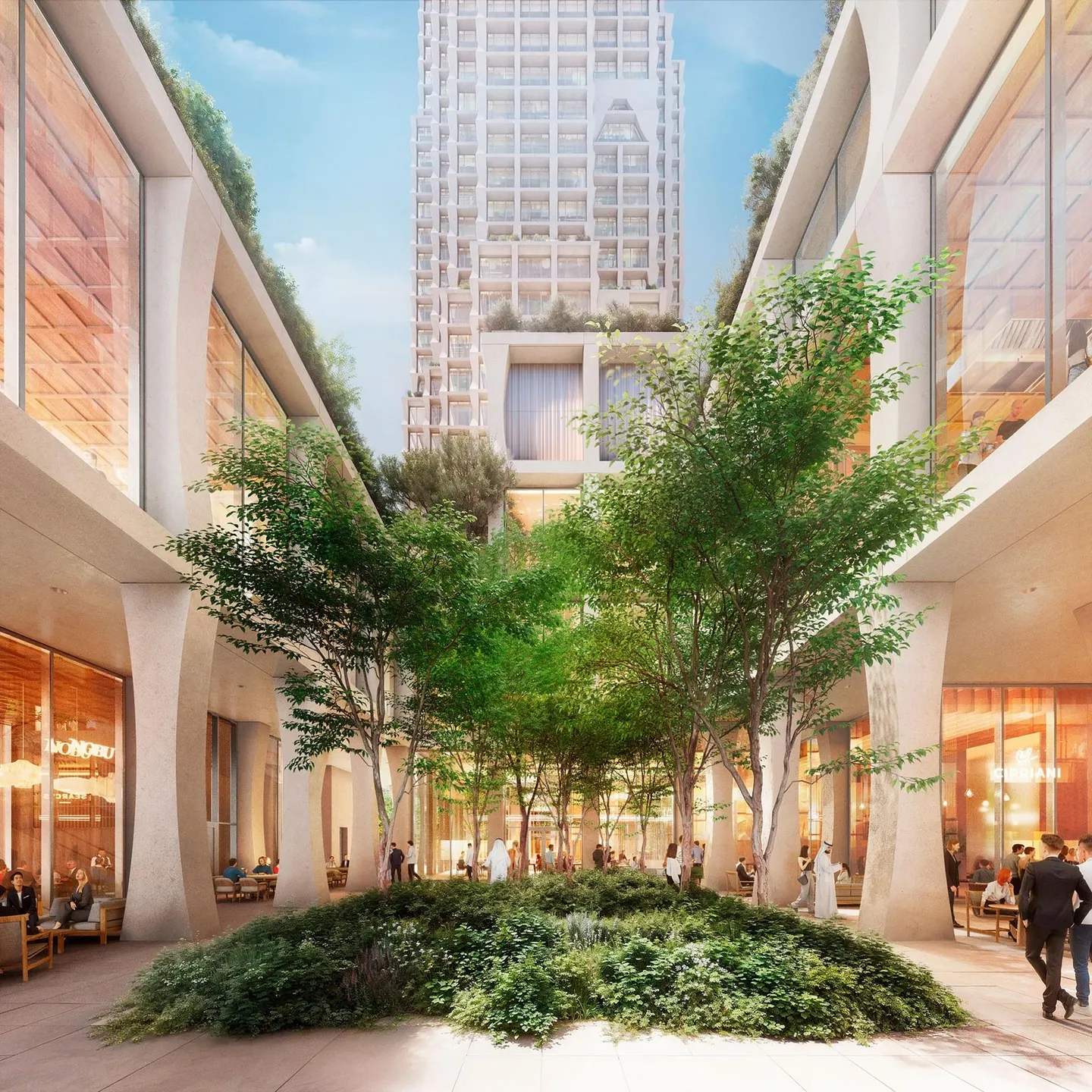
Janu Dubai is another mixed-use project already under way. The 1.3 million-square-foot structure is backed by Dubai’s H&H and was planned before the Shinsegae deal. Janu Dubai is slated to open in the Dubai International Financial Centre next year, with a 150-room hotel, 57 branded residences, office spaces, publicly accessible retail and the first Janu Club, a new invitation-only social membership.
What This Means For The Future Of Aman
The joint venture gives Doronin a financing vehicle for future projects similar to One Beverly Hills and Janu Dubai, which combine hotels, branded residences, private clubs and commercial space. The agreement also creates additional opportunities for Aman to earn revenue with less of the company’s corporate capital tied up in the underlying real estate.
Doronin declined to identify the first project of the new joint venture, saying it was too early to confirm its location or brand. He also cautioned against treating One Beverly Hills or Janu Dubai as a template.
“Every project is unique, so I wouldn’t point to any one development as a blueprint for the future,” Doronin writes. “I am very specific about what I’m looking for and am personally involved.”
Article by Katharina Kotrba, Contributor. Article Source.